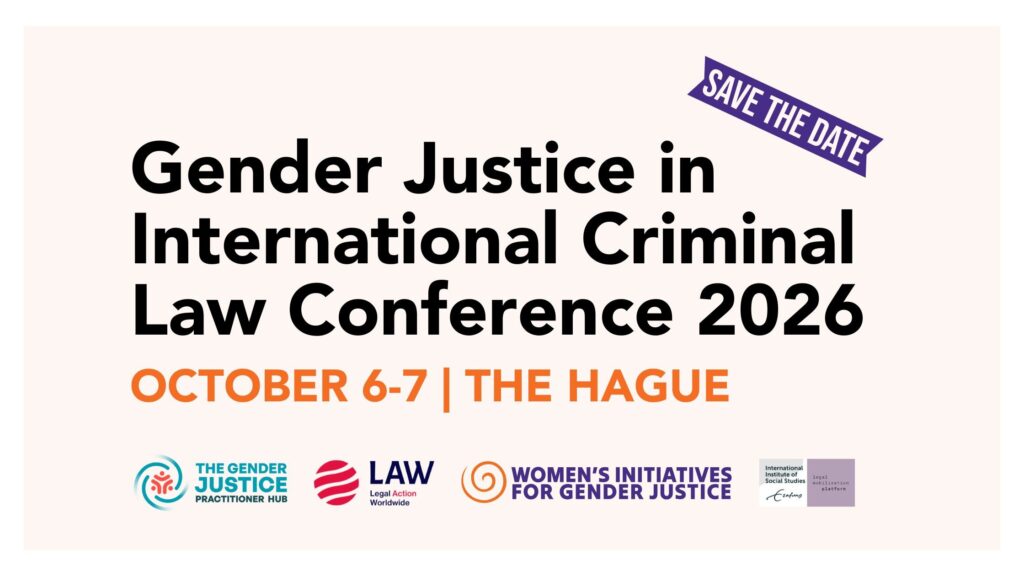
Mark your calendars! The 2026 Gender Justice in International Criminal Law Conference will take place on the 6th and 7th of October, in person in The Hague, and online. More details and registration to follow.
The annual Gender Justice in International Criminal Law Conference is part of the commitment of the Gender Justice Practitioner Hub to facilitating strategic and practitioner-oriented discussions to strengthen gender justice outcomes for conflict-related crimes.
This year’s focus turns to Asia, with sessions being planned on Afghanistan, Iran, and Myanmar along with a range of topic-based discussions on issues at the cutting edge of international criminal law practice. GJP Hub looks forward to collaborating with existing and new partners to ensure the Conference dialogue and regional follow-up action is driven by the perspectives and voices of those directly affected.
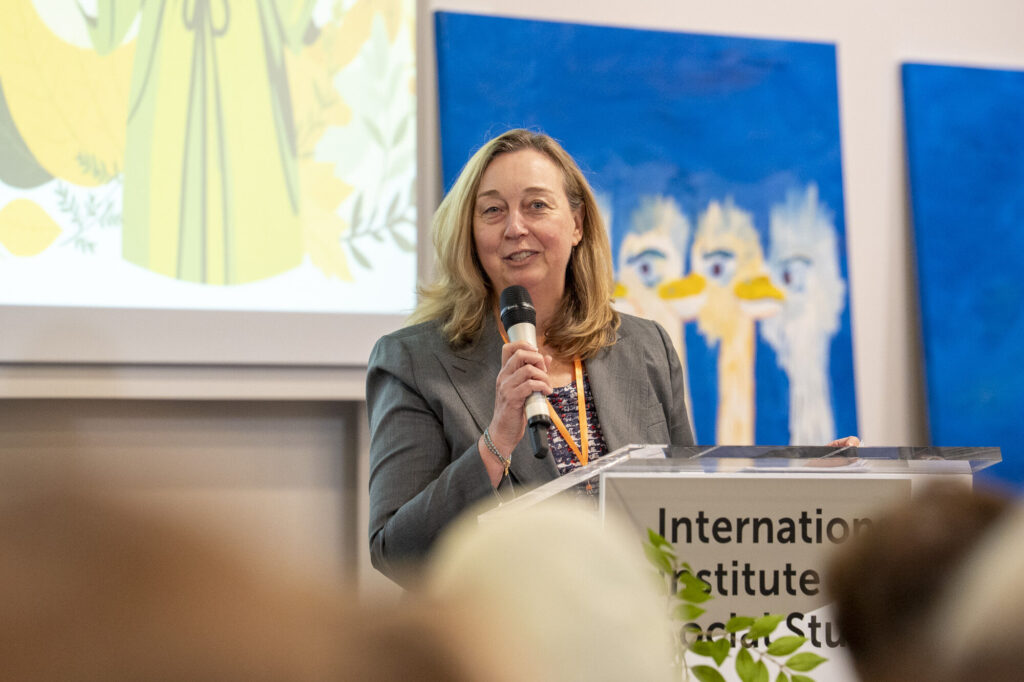
The 2026 Conference builds on the momentum generated during the 2025 Gender Justice in International Criminal Law Conference. Over two days in September 2025, fifty-six speakers from across the globe led discussions on pressing gender justice issues including: solidarity in the face of attacks on gender justice; accountability in the MENA region, including Palestine and Syria; reproductive violence as a strategy of genocide; gender-sensitive institution building; and next-generation strategies in the international criminal law field.
The 2025 Conference report captures the key insights, strategic conclusions, and concrete commitments that emerged, including the urgent need to move from rhetoric to operational solidarity, and from normative commitments to practitioner-driven action.
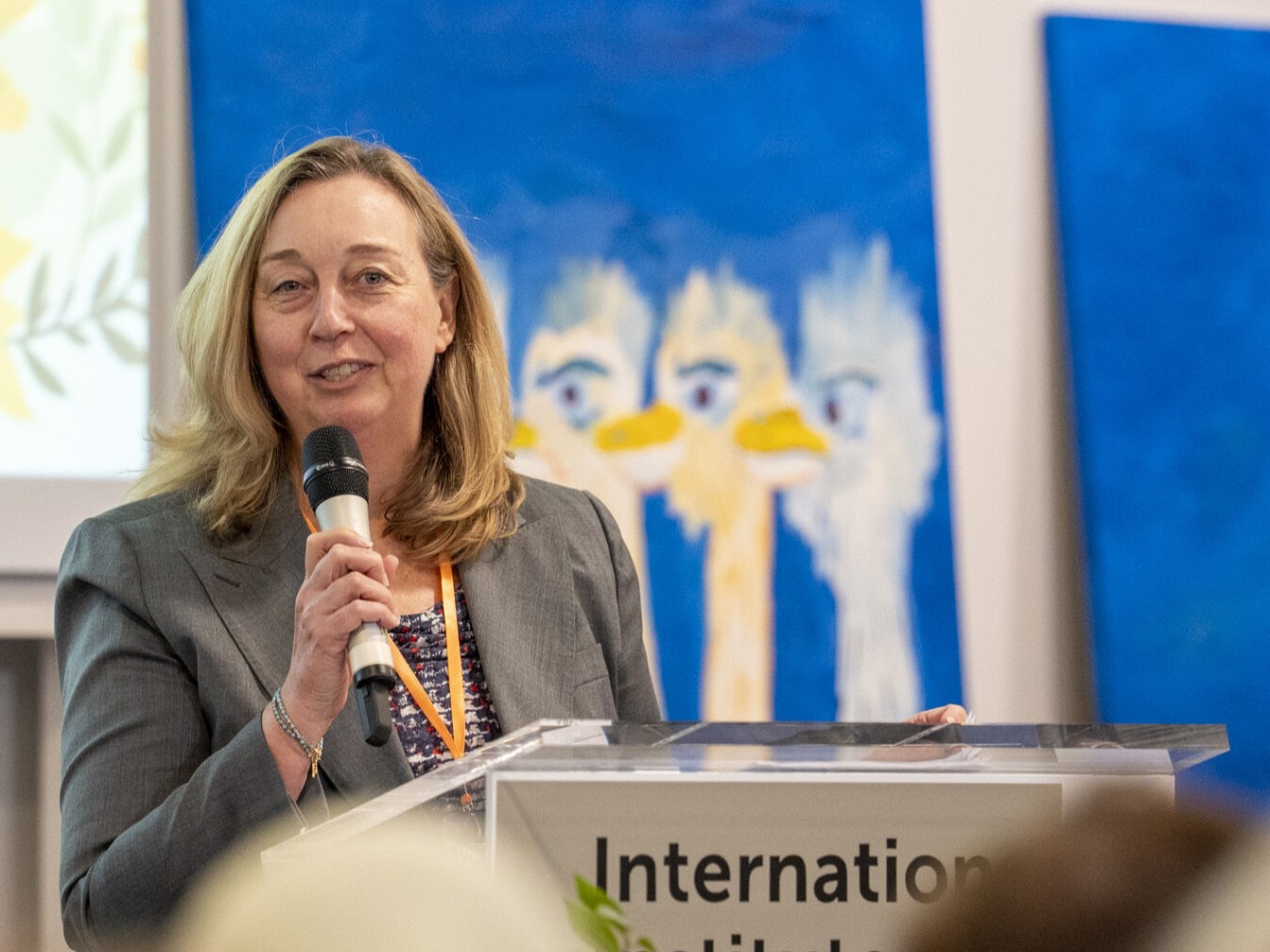
The Gender Justice Practitioner Hub (GJP Hub) and Legal Action Worldwide (LAW) are honored to announce the appointment of Michelle Jarvis as the new Executive Director of the GJP Hub. A distinguished prosecutor with over two decades of experience in international criminal justice, Ms. Jarvis joins the Hub at a critical juncture in the global pursuit of accountability for gender-based crimes.
“I am deeply honored to lead the Gender Justice Practitioner Hub at a time when the need for a coordinated and strategic approach to gender justice has never been more urgent,” Jarvis said. “From Syria and Myanmar to Iran and beyond, we see the persistent barriers that prevent survivors from accessing gender justice. My goal is to ensure the Hub acts as a vital bridge, channeling comprehensive gender expertise into every stage of the legal process to ensure that no survivor is left behind by systems ill-equipped to see them.”
Strengthening the Path to Justice
By moving beyond a singular focus on sexual violence to address the broader spectrum of gendered harms arising during conflict, the Hub aims to dismantle the specific barriers disadvantaged groups face when seeking redress, to secure equal and meaningful outcomes for victims and survivors of war crimes, crimes against humanity, and genocide.
“Michelle Jarvis is a visionary whose career has been defined by a commitment to inclusive justice,” said Antonia Mulvey, LAW’s Executive Director. “Her expertise in international prosecutions across conflict zones is a huge asset for the GJP Hub. Together, we will ensure that future accountability processes are inherently gender-just and truly impactful.”
A Legacy of Impactful Leadership
Ms. Jarvis, an Australian national, brings a wealth of expertise from the highest levels of international criminal law practice. Most recently, she served as the Deputy Head of the International, Impartial and Independent Mechanism (IIIM) for Syria. Her career includes pivotal roles as Deputy to the Prosecutor at the ICTY and the RMICT, where she acted as counsel in precedent-setting cases that shaped the landscape of international criminal law.
Throughout her career, Ms. Jarvis has been a tireless advocate for marginalized groups, initiating proactive strategies that center victims and survivors within the justice process.
________________________________________
For more information on our mission and our Advisory Board, please visit https://www.gjphub.org/
In recent years, a well-funded, well-organised anti-gender movement has gained momentum globally, undermining gender equality efforts by spreading misinformation, influencing policies, and restricting rights, creating a significant challenge for practitioners and institutions advocating for inclusive justice.
The impact of the anti-gender movement can be clearly seen in legislative and policy reform reversing, limiting and/or slowing progress towards gender equality around the world. The anti-gender movement is not new but has recently gathered pace and intensity in the Global North. It is recognised that activists in the Global South have long-confronted deeply entrenched opposition from the anti-gender movement and have vital experience and critical strategies to share. There is escalating global hostility on gender, including on specific issues such as LGBTQIA+ rights, sexual and reproductive health, and diversity, equity, inclusion (DEI), and the prevailing narrative appears to be one that threatens to entrench inequality worldwide.
There have also been impacts at an operational level within justice and accountability institutions. Preliminary information suggests there is a risk of pressure to a) reduce focus or deprioritise investigation into gendered crimes or human rights violations which predominantly affect women or girls, and b) to remove gender-competent and intersectional approaches from analysis of crimes and violations, writ large. There are also instances of ‘pre-emptive compliance’ – i.e. individuals or institutions scaling back work on gender or gendered issues in anticipation of formal direction to do so or due to an impression that gender analysis is no longer a requirement. These pressures coincide with increasing direct institutional challenges: the US has pressured UNICEF and UN Women to end promotion of DEI, and gender ideology, while other states have also announced significant cuts to funding for gender programming within the UN system.
These challenges come at a critical time for the meaningful incorporation of gender into justice and accountability initiatives. In Syria, Afghanistan, Ukraine and Sudan, justice facilitation opportunities are emerging now – future gender justice outcomes will be undermined and diminished unless concrete steps are taken soon to prioritise gender where these opportunities arise.
With this in mind, the Gender Justice Practitioner Hub has launched a series of online discussions that are bringing practitioners together to explore the impact of this movement, with a view toward developing tools, support mechanisms, and strategies for countering these challenges. These conversations will also help shape this year’s Gender and International Criminal Law Conference, which is expected to take place in October 2025.